The fabulous cooking and recipe magazine Cooking Light has launched a nationwide search to find the chef with the healthiest and most innovative cooking approach.
The contest, open to both self-taught cooks or professionally-trained chefs, launches today at www.CookingLight.com/castingcall and runs through August 14, 2010.
Entrants must submit a three-minute prep-to-plate video of a healthy, original recipe on which they will be judged. Four finalists will be chosen from the entries to compete in a live cook-off event at The Taste of Atlanta, a two-day outdoor food festival in Atlanta, GA, on October 23 and 24, 2010.
The Cooking Light judges will select the winner, who will be named the “Healthy Chef of the Year.”
The winner will receive:
--$10,000 prize package including a kitchen makeover
--a year's worth of free groceries
--the opportunity to become a contributor to Cooking Light magazine and CookingLight.com in 2011.
Any and all skill levels are welcome to enter, from home cooks to culinary school graduates. Entrants must be legal residents of the United States and 21 years or older at the time of entry. Anyone who is paid to cook for a living is not eligible to enter.
Click here to enter!
Cooking Light is the nation’s number one epicurean brand with the largest audience, most epicurean editorial and the most recipes. Founded in 1987, Cooking Light makes healthy food taste great. Each month, nearly 12 million readers turn to Cooking Light and CookingLight.com for innovative recipes; nutrition advice and food and fitness tips. Cooking Light is published by a subsidiary of Birmingham, Alabama-based Southern Progress Corporation.
Monday, June 14, 2010
Healthy Cooks contest! WIN $10,000 from Cooking Light magazine


Tuesday, April 27, 2010
Savory Honey Scones by Tea Expert Lisa Boalt Richardson
 A good cup of tea can be transcendant, warming chilled bones, soothing frayed nerves, or settling a tired body after a busy day. It is shared with a good book, over good conversation, or when in presence of royalty. The many methods of enjoying tea can take us far beyond the comfort of our own kettle. China, Morocco, France, England, Kenya, and Russia are all tea-drinking countries with their own unique serving traditions and tea preparations. Lisa Boalt Richardson’s latest book, The World in Your Teacup: Celebrating Tea Traditions, Near and Far
illuminates the rich culture of tea around the world. For each of eight different countries, you’ll learn about the culture and history of tea, how tea is served there, how to prepare tea in the style of the country, and which foods (recipes included!) can accompany the tea.
Stunning photographs by Lauren Rubinstein, one of Atlanta’s premier food photographers, illustrate the wide variety of teas and accompanying menus eaten all over the world.

1-1/3 cups all-purpose flour
1-1/3 cups semolina (I'm trying gluten-free all-purpose flour for all the flour in this recipe)
2 teaspoons baking powder
1/2 teaspoon baking soda
1/2 teaspoon coarse salt
6 ounces soft goat cheese
1/4 cup honey
1/2 cup heavy cream, divided
1 egg
Preheat oven to 425 degrees.
In a large bowl, mix 2 teaspoons rosemary with all the other dry ingredients. Add goat cheese to the dry ingredients and set aside.
Whisk together honey, half the cream, and egg. Stir this mixture into the dry ingredients until a soft dough forms.
Form the dough into a ball. Turn out onto a floured surface and separate the dough into 2 equal portions and pat each portion into a circle about 3/4 inch thick. Cut into 16 wedges. Separate and arrange wedges on a baking sheet.
Brush tops with remaining cream and sprinkle with remaining rosemary. Place in oven and bake 1o to 12 minutes or until golden brown. It is yummy to serve these with butter, honey, and/or softened goat cheese! Makes 16 scones.
Thursday, April 22, 2010
Exquisite Mother's Day foodie gifts she'll actually want!
 Caren Wize, chef and owner of Truly Wize Bakery, makes delicious all natural, gluten free products that are beautifully packaged in eco-friendly gift boxes. We recommend Assorted Macaroons, the extra rich and moist Gluten Free Brownies, and the fruit flavor filled Whoopie Pies.

 e Sampler, a selection of Kohana’s best roasted coffees, or the Flowering Teas Sampler from Great Lakes Tea and Spice. The teas are absolutely gorgeous served in a clear class pot or cups.
Tuesday, November 10, 2009
Press coverage in Orange County Register!
I am positively blushing--but excited--about my coverage today in the Orange County Register.
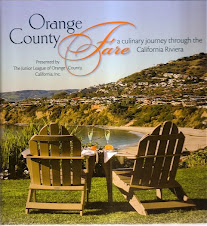
"Orange County Fare: A Culinary Journey Through the California Riviera," the first cookbook produced by the Junior League of Orange County in more than 20 years, is a finalist in the cookbook category of the 2009 National Best Books Awards sponsored by USA Book News. The book focuses on fresh California-style cuisine – colorful dishes easily mastered by the home cook.
One of the recipes featured is by Rebecca Lacko of Capistrano Beach. Here's a closer look:
Rebecca Lacko of Capistrano Beach donated her recipe Chicken Sausage Crostini to the Junior League of Orange County's cookbook, "Orange County Fare: A Culinary Journey Through the California Riviera."
Q. What was it like to be included in the new Junior League cookbook?
A. I was absolutely flattered to have my recipe appear in the same book with chef Jeff Lavia, chef Jamie Gwen, Richard Nixon, John Stamos and Vanna White. The proceeds from the book directly impact our Orange County neighbors and friends.
Q. What is your recipe?
A. I was pleased to donate my recipe Chicken Sausage Crostini (Page 21) to JLOCC, which devotes its trained volunteers and resources to five community projects focusing on the improvement of the lives of families in our community. The current projects are Orangewood Mentoring Program Activities, Florence Crittenton Services, CHOC Reading Program, CASA (Court Appointed Special Advocates) Emancipated Youth Program, and Orangewood Kinship. Through these projects, JLOCC returns more than $50,000 and gives more than 1,500 volunteer hours to the Orange County community each year.
Q. What is your full-time job?
A. Mother to two young boys, produce a national column on green living, and write for a variety of national publications and Web sites.
Q. What were your career dreams as a kid?
A. I always wanted to be in some creative field – writing, painting or singing, although I can barely carry a tune. I can remember relishing the idea of being able to live anywhere in the world while weaving stories for readers or painting scenes from my adventures on canvas. And I always wanted lots and lots of kids.
Q. When did you become interested in writing about food?
A. I began writing about food and nutrition more than six years ago. It seemed natural and effortless because I am always thinking about eating good food and I want others to join me. I'm also curious about how different kinds of food and spices can heal or provide specific nutrients, and how they grow or earned a peculiar name. Creating and sharing a nutritious meal with friends and family is, in my opinion, a great act of love.
Q. How so?
A. Humankind has been gathering to eat since the dawn of time, and it is a ritual that honors and nourishes everyone at the table. When we can make something that tastes good, fuels the body and is pleasing to the senses, we have in essence, created art. This may seem a lofty perspective on something as routine as eating, but when you stand back and study the process of preparing food and feeding others, there is a lucid beauty to the task.
Q. Why do you think volunteering is important?
A. We all know in our hearts how important social programs are to those in need. Living in close proximity to the ocean, we also are reminded to be good stewards of our environment. However, studies prove volunteering benefits the volunteer the most. When we give, we truly receive. A community can only be as healthy, vibrant and active as its members are willing to make it. As Dr. Albert Schweitzer remarked, "The only ones among you who will be really happy are those who will have sought and found how to serve."
"Orange County Fare" is available at www.orangecountyfare.com ($29.95), as well as Friday through Sunday at The Christmas Co. at the OC Fair & Event Center (fairgrounds), 88 Fair Drive, Costa Mesa. For more information, visit www.jlocc.org.
ABOUT REBECCA LACKO
Born and raised: Ontario, Canada
Food heroes: chefs Bobby Flay, Alice Waters and Tanya Petrovna
Family: husband, Joseph; two sons, Joseph, 4, and Noah, 2
Favorite quote: "Our deepest fear is not that we are inadequate. Our deepest fear is that we are powerful beyond measure." – Marianne Williamson
Hobbies/spare time: reading, going for walks or hikes, traveling, cooking, painting, yoga and dance, playing with her kids
Motto: "When you look at your troubles from God's point of view, you realize that everything is working together for good. Meet every circumstance with forgiveness and joy."
Working on: a fiction book about an Orange County-based family, and beginning the outline for a nonfiction book that will be a series of essays about living by design
Tuesday, November 3, 2009
When good food becomes dangerous--experts weigh in
In many cases, the methods of today's food producers are neither clean nor sustainable. The result is damage to our health, the environment-or both. Prevention magazine's Anne Underwood decided to take a fresh look at food through the eyes of food scientists, by asking a simple question: "What foods do you avoid?" Their answers don't necessarily make up a "banned foods" list. But reaching for the suggested alternatives might bring you better health—and peace of mind.
What the endocrinologist won't eat: canned tomatoes
Fredrick Vom Saal, Ph.D., is an endocrinologist at the University of Missouri who studies bisphenol-A (BPA).
The problem: The resin linings of tin cans contain bisphenol-A, a synthetic estrogen that has been linked to ailments ranging from reproductive problems to heart disease, diabetes and obesity. Unfortunately, acidity (a prominent characteristic of tomatoes) causes BPA to leach into your food. Studies show that the BPA in most people's body exceeds the amount that suppresses sperm production or causes chromosomal damage to the eggs of animals. "You can get 50 mcg of BPA per liter out of a tomato can, and that's a level that is going to impact people, particularly the young," says vom Saal. "I won't go near canned tomatoes."
The solution: Choose tomatoes in glass bottles (which do not need resin linings). You can also get several types in Tetra Pak boxes, like Trader Joe's and Pomi.
What the farmer won't eat: corn-fed beef
Joel Salatin is co-owner of Polyface Farms and author of several books on sustainable farming.
The problem: Cattle evolved to eat grass, not grains. But farmers today feed their animals corn and soybeans, which fatten up the animals faster for slaughter. But more money for cattle farmers (and lower prices at the grocery store) means a lot less nutrition for us. A recent comprehensive study conducted by the USDA and researchers from Clemson University found that compared with corn-fed beef, grass-fed beef is higher in beta-carotene, vitamin E, omega-3s, conjugated linoleic acid (CLA), calcium, magnesium and potassium; lower in inflammatory omega-6s; and lower in saturated fats that have been linked to heart disease. "We need to respect the fact that cows are herbivores, and that does not mean feeding them corn and chicken manure," says Salatin.
The solution: Buy grass-fed beef, which can be found at specialty grocers, farmers' markets and nationally at Whole Foods. It's usually labeled because it demands a premium, but if you don't see it, ask your butcher. You can also buy direct from a local farmer, which can be as cheap as $5 per pound. To find a farmer near you, search eatwild.com.
What the toxicologist won't eat: microwave popcorn
Olga Naidenko, Ph.D., is a senior scientist for the Environmental Working Group.
The problem: Chemicals, including perfluorooctanoic acid (PFOA), in the lining of the bag, are part of a class of compounds that may be linked to infertility in humans, according to a recent study from UCLA. In animal testing, the chemicals cause liver, testicular and pancreatic cancer. Studies show that microwaving causes the chemicals to vaporize—and migrate into your popcorn. "They stay in your body for years and accumulate there," says Naidenko, which is why researchers worry that levels in humans could approach the amounts causing cancers in laboratory animals. DuPont and other manufacturers have promised to phase out PFOA by 2015 under a voluntary EPA plan, but millions of bags of popcorn will be sold between now and then.
The solution: Pop natural kernels the old-fashioned way—in a skillet. For flavorings, you can add real butter or dried seasonings.
What the farm director won't eat: nonorganic potatoes
Jeffrey Moyer is the chair of the National Organic Standards Board.
The problem: Root vegetables absorb herbicides, pesticides, and fungicides that wind up in soil. In the case of potatoes—the nation's most popular vegetable—they're treated with fungicides during the growing season, then sprayed with herbicides to kill off the fibrous vines before harvesting. After they're dug up, the potatoes are treated yet again to prevent them from sprouting. "I've talked with potato growers who say point-blank they would never eat the potatoes they sell. They have separate plots where they grow potatoes for themselves without all the chemicals," says Moyer, who is also farm director of the Rodale Institute.
The solution: Buy organic potatoes. Washing isn't good enough if you're trying to remove chemicals that have been absorbed into the flesh.
What the fisheries expert won't eat: farmed salmon
David Carpenter, M.D., director of the Institute for Health and the Environment at the University at Albany, published a major study in the journal Science on contamination in fish.
The problem: Nature didn't intend for salmon to be crammed into pens and fed soy, poultry litter and hydrolyzed chicken feathers. As a result, farmed salmon is lower in vitamin D and higher in contaminants, including carcinogens, PCBs, brominated flame retardants, and pesticides such as dioxin and DDT. According to Carpenter, the most contaminated fish come from Northern Europe, which can be found on American menus. Preliminary science has also linked DDT to diabetes and obesity. There is also concern about the high level of antibiotics and pesticides used to treat these fish. When you eat farmed salmon, you get dosed with the same drugs and chemicals.
The solution: Switch to wild-caught Alaska salmon. If the package says fresh Atlantic, it's farmed. There are no commercial fisheries left for wild Atlantic salmon.
What the cancer researcher won't drink: milk produced with artificial hormones
Rick North is project director of the Campaign for Safe Food at the Oregon Physicians for Social Responsibility and former CEO of the Oregon division of the American Cancer Society.
The problem: Milk producers treat their dairy cattle with recombinant bovine growth hormone (rBGH or rBST, as it is also known) to boost milk production. But rBGH also increases udder infections and even pus in the milk. It also leads to higher levels of a hormone called insulin-like growth factor in milk. In people, high levels of IGF-1 may contribute to breast, prostate and colon cancers. "When the government approved rBGH, it was thought that IGF-1 from milk would be broken down in the human digestive tract," says North. As it turns out, the casein in milk protects most of it, according to several independent studies. "There's not 100 percent proof that this is increasing cancer in humans," admits North. "However, it's banned in most industrialized countries."
The solution: Check labels for rBGH-free, rBST-free, produced without artificial hormones or organic milk. These phrases indicate rBGH-free products. Try Wal-Mart's Great Value label, which does not use rBGH.
The organic-foods expert won't eat: conventional apples
Mark Kastel, a former executive for agribusiness, is codirector of the Cornucopia Institute, a farm-policy research group that supports organic foods.
The problem: If fall fruits held a "most doused in pesticides contest," apples would win. Why? They are individually grafted (descended from a single tree) so that each variety maintains its distinctive flavor. As such, apples don't develop resistance to pests and are sprayed frequently. The industry maintains that these residues are not harmful. But Kastel counters that it's just common sense to minimize exposure by avoiding the most doused produce, like apples. "Farm workers have higher rates of many cancers," he says. And increasing numbers of studies are starting to link a higher body burden of pesticides (from all sources) with Parkinson's disease.
The solution: Buy organic apples, or you can't afford organic, be sure to wash and peel them. But Kastel personally refuses to compromise.
Thursday, October 22, 2009
Classic Moosewood Mushroom, Tofu, Walnut Stuffed Acorn Squash
 We love the library. The library doesn't always love us. My children--ages 2 and 4 years--have had, historically, only two speaking volumes: loud and louder. (They've gotten better recently.)
Along the way, we have been consecutively and repeatedly kicked out of no less than four regional libraries. Our disgrace has resulted in more than a few late charges--it's tough to remember from where we had the nerve to borrow books last, and when they might be due.
My solution? Visit only the library's bookstore. Most children's books are only 10 cents (much less than a late fee), our purchase funds the library's services, other patrons are less likely to "shush" us, and we get to keep the books we select. Dignity restored!
On one such visit, I treated myself to a perfect-bound treasure in the form of a Moosewood Restaurant cookbook, circa 1987; The recipes' familiar ingredients remind me of my long-ago macrobiotic days. This colorful, vegan version of stuffed acorn squash is hearty and complex. Moosewood suggests it as a "perfect Thanksgiving alternative to turkey." (For the bread crumbs, my boys and I spent a rainy morning baking a whole grain, gluten-free loaf. Yum!)
4 small acorn squashes, halved and seeded (Roast the seeds!)
1 cake of tofu, pressed and cut into small cubes
3 tablespoons tamari soy sauce (perfect for the gluten-free set)
3 tablespoons dry sherry
4 cups small bread crumbs
2 tablespoons vegetable oil
3 cups onion, chopped
3 celery stalks, chopped
4 cups (1 pound) mushrooms, sliced
1 teaspoon marjoram, dried
1/5 teaspoon thyme, dried
1/2 cup vegetable stock
1 cup walnuts or pecans, toasted and chopped
1 tablespoon fresh lemon juice
Place the squash halves, cut side down, in an oiled baking pan and bake at 350 degrees for about 40 minutes, until the squash is just tender. Meanwhile, marinate the tofu in the soy sauce and sherry. Toast the bread crumbs on a baking sheet for 5 minutes.
Saute the onions and celery in 2 tablespoons oil, using a pot large enough for all the remaining ingredients. When the onions are translucent, add the mushroom, marjoram, thyme and stock. Cook covered for 10 minutes, then add the tofu with its marinade and the bread crumbs. Saute for another 5 minutes. Adjust the seasoning. Remove from the heat. Stir in the nuts and lemon juice.
Mound the filling in the baked squash halves and bake covered at 350 degrees for 20 minutes.
Food fact! Shaped like a ribbed acorn, this winter squash is sweeter than summer squash because of its longer growing period; Prime season for acorn squash is early fall through winter. Most often acorn squash has a green exterior, although you may also find orange and white acorn squash varieties. Once home from the market, acorn squash may be stored up to one month in a cool (50-55 degrees F.) cellar or storage area--but only about two weeks in the refrigerator. Only cut or cooked acorn squash requires refrigeration.
Acorn squash is rich in beta-cryptoxanthin, an orange-red carotenoid, and may significantly lower one's risk of developing lung cancer. A study published in Cancer Epidemiology, Biomarkers and Prevention reviewed dietary and lifestyle data collected from over 60,000 adults in China and found that those eating the most crytpoxanthin-rich foods showed a 27% reduction in lung cancer risk. This was especially good news among the smokers evaluated; Those who were in the group consuming the most cryptoxanthin-rich foods were found to have a 37% lower risk of lung cancer compared to smokers who ate the least of these health-protective foods.
The same benefits are extended to second-hand smokers and emphysema sufferers, suggests research conducted by Richard Baybutt, associate professor of nutrition at Kansas State.
Friday, October 16, 2009
Gluten free, tested, delicious recipes for special diets: Chicken entrees (Part 3)
 It is better to pay the grocer than the doctor.
According to Dr. Eydi Bauer, author of the must-read new book, Life After Bread, in the US, we spend "twice as much on healthcare as any other country spends, yet we're generally in poorer health."
Dr. Bauer states that, "we are becoming sicker because of what we eat, and common foods are often the source of our health imbalances. Every street corner offers both the posion (gluten) and a pharmaceutical remedy for the resulting pain and discomfort ... We need a paradigm shift."
Here are some easy and elegant chicken entrees from The Unassuming Foodie:
- Divine Basil-Walnut Chicken Usually, the purchase of fresh basil results in homemade pesto. I have to admit, however, that pine nuts do very little to inspire me. Walnuts, on the other hand, can reduce the damaging effects of fats on blood vessels according to a 2006 study published in the Journal of the American College of Cardiology, can lower LDL cholesterol by 10%, and taste downright gorgeous, especially when roasted.
Arugula, Feta, and Olive Stuffed Chicken Thighs Given the choice between Greek or Caesar salad, do you always spring for the Greek? When you breeze past a display of gourmet olives at your neighborhood deli or upscale grocer, are you instantly intrigued? This is for you!
Stuffed Chicken with Fresh Sage in Prosciutto Envelopes This recipe is so impressive-looking and utterly satisfying, I've served it at a formal Christmas Eve dinner, and conversely I've chopped into tiny pieces to my 13-month-old, who shows increasingly good taste.
Crusty Herbed Chicken This is similar to a breaded and spiced, fried chicken dish---without the fat and flour!
Roast Chicken with Smoked Paprika and Fresh Thyme Spanish Smoked Sweet Paprika is also known as Pimenton de la Vera, Dulce. It is a popular ingredient in many Mediterranean recipes, and its flavor is essential for authentic Spanish cooking.
For more info:
Gluten free, kid tested, and foolproof recipes for special diets (Part 1)
For many children, gluten intolerance is typically demonstrated as "off-the-wall irrational" behavior. A father of a gluten intolerant child... Keep Reading »
Gluten free, tested, delicious recipes for special diets: Soup and salad (Part 2)
A recent Mayo Clinic study found a dramatic increase in the number of cases of gluten intolerance; Interestingly, the group most affected is women in...Keep Reading »
Gluten free, tested, delicious recipes for special diets: Soup and salad (Part 2)
A recent Mayo Clinic study found a dramatic increase in the number of cases of gluten intolerance; Interestingly, the group most affected is women in their 40s, 50s and 60s.
Here are some nutritious, elegant choices for gluten-free dining:
- Roasted Edamame Salad Edamame is just a fancy name for boiled green soybeans in salt water. In East Asia, the soybean has been used for over two thousand years as a major source of protein. Edamame offers a whopping 9 grams in a half-cup serving, about the same amount you'll find in 4 slices of whole-wheat bread or 4 cups of steamed zucchini!
- Japanese Style Cucumber Salad Unlike ubiquitous mayonnaise-based potato or macaroni salad, this one only gets better over time. Make it in the morning after breakfast--By the time guests arrive for an afternoon gathering, the salad's flavor is at its peak.
- Gramma's Cottage Bean and Ham Soup This recipe features peameal bacon, a cured pork loin that has not been smoked, and is rolled in cornmeal. It is not to be confused with bacon sold as "Canadian Bacon", which is more of a ham in texture and flavor.
Gluten free, kid tested, and foolproof recipes for special diets (Part 1)
For many children, gluten intolerance is typically demonstrated as "off-the-wall irrational" behavior. A father of a gluten intolerant child... Keep Reading »
Is medical tourism a blessing or call for healthcare reform?
High-quality care is available at many hospitals around the world that are centers of excellence with quality outcomes and standards of service... Keep Reading »